GoDaddy
NOMINEE OVERVIEW
The GoDaddy Developer Portal gives developers direct programmatic access to the same platform capabilities that power GoDaddy's products (domains, commerce, email, auctions, hosting, and shopping) through standard REST APIs, a purpose-built CLI, and an MCP server for AI agents.
The portal replaces GoDaddy's previous developer experience, which contained legal constraints limiting access to a small subset of GoDaddy customers. The new portal inverts that approach: access is available to every customer, visible on the homepage without login, every how-to guide ships with copy-paste examples in curl, Node.js, Python, Go, and the GoDaddy CLI, and a developer can make their first authenticated API call in under five minutes.
What makes this portal distinctive is its treatment of AI coding agents as first-class users. Every actionable how-to page carries structured agent metadata (like permissions, required scopes, idempotency, destructive flags, and failure-recovery guidance) so that an LLM can plan and validate API calls without hallucinating endpoints or skipping safety checks. The portal publishes machine-readable documentation through llms.txt, a full-corpus text export, per-page Markdown endpoints, and reference documentation specs.
The result is a portal that serves both human developers reading guides and AI agents consuming structured context. All of this is built on the same content, governed by the same accuracy standards.
NOMINATION RATIONALE
1) BEST REIMAGINED ONBOARDING EXPERIENCE IN A DEVELOPER PORTAL
Why is this category a strong match?
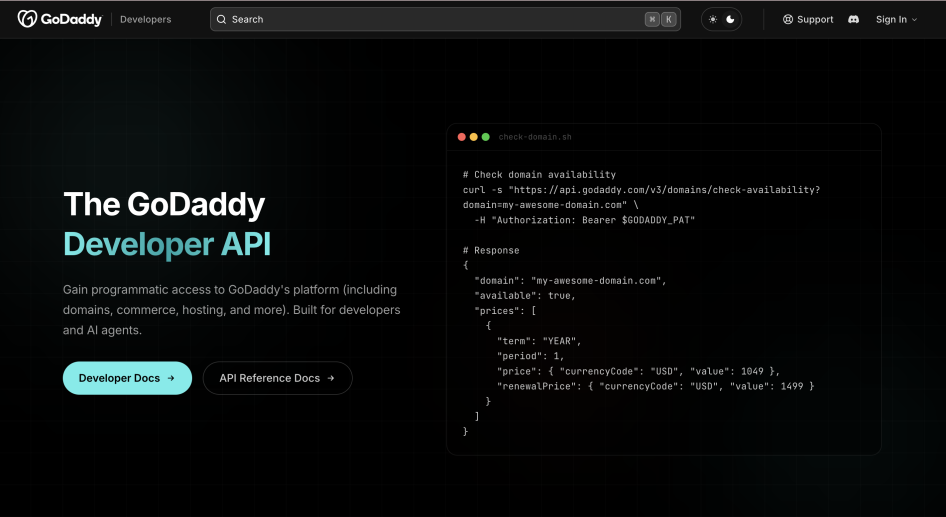
We replaced a legal-first, Swagger-only developer experience with onboarding that shows working code before signup. A developer makes a first authenticated API call in under five minutes.
We also built a parallel onboarding path for AI coding agents. An agent can plan a valid integration without human guidance.
In what ways does your portal shine in this category?
- Code before signup: The homepage shows a live curl example (domain availability check with a mock response) with no login.
- Three-step Quickstart: Export your credential, run a curl command, interpret the response. A common-errors table maps each likely failure to its cause and fix.
- Routing by product: Tabbed navigation sends developers to Domains, Auctions, Commerce, Hosting, Shopping, or Email getting-started paths.
- Agent path: A curated llms.txt index; a "Testing with LLMs" guide with a starter prompt, hard constraints (prefer v3, use OTE for writes, never invent endpoints), and a five-point validation checklist; a public MCP server that needs no credentials; and agentNotes metadata (permissions, scopes, idempotency, destructive flags, failure recovery) on over 30 how-to pages.
2) BEST UNIFIED OR FEDERATED ENTERPRISE DEVELOPER PORTAL
Why is this category a strong match?
We unify six product domains under one portal: Domains, Auctions, Commerce, Email, Hosting, and Shopping. They share conventions for authentication, errors, rate limiting, pagination, and CLI access.
A developer who learns one domain can predict how the others behave.
In what ways does your portal shine in this category?
- Shared conventions, documented once: A unified error envelope with machine-readable codes, consistent Bearer token authentication (with documented legacy fallback), a single rate-limit policy, and one CLI across all API areas.
- Scale: Over 100 guide pages, almost 300 API reference pages, a filterable per-API changelog, and troubleshooting pages by failure category.
- Navigation: Related-links components on guides, plus sidebar separators and domain-specific icons.
- Unified machine surfaces: One llms.txt covers the whole portfolio, per-page Markdown export works across all domains, and every OpenAPI spec follows the same structural conventions.
3) BEST API PRODUCT MICROPORTAL INSIDE A DEVELOPER PORTAL
Why is this category a strong match?
The Domains section works as a self-contained microportal for the full domain lifecycle. A developer can go from search to purchase to ongoing management without leaving it.
It makes a complex API domain approachable without losing technical depth. That complexity includes three API versions, paid operations, consent requirements, and async workflows.
In what ways does your portal shine in this category?
- Organized by task, not endpoint: "Search for domains" (availability, suggestions, pricing comparison); "Register a domain" (quote-then-execute with idempotency and consent handling); "Manage your domains" (DNS, contacts, renewals, lock, forwarding).
- End-to-end workflow guides: The domain lifecycle and API integration patterns tie individual operations into complete business scenarios.
- Examples in five tools: curl, Node.js, Python, Go, and the GoDaddy CLI, plus structured agent metadata and cross-references to the OpenAPI spec.
- Pricing transparency: A TLD-specific table covers registration, renewal, and standard rates.
- Version guidance: Prefer v3 for new integrations, with documented fallbacks for capabilities not yet in v3.