Adyen
NOMINEE OVERVIEW
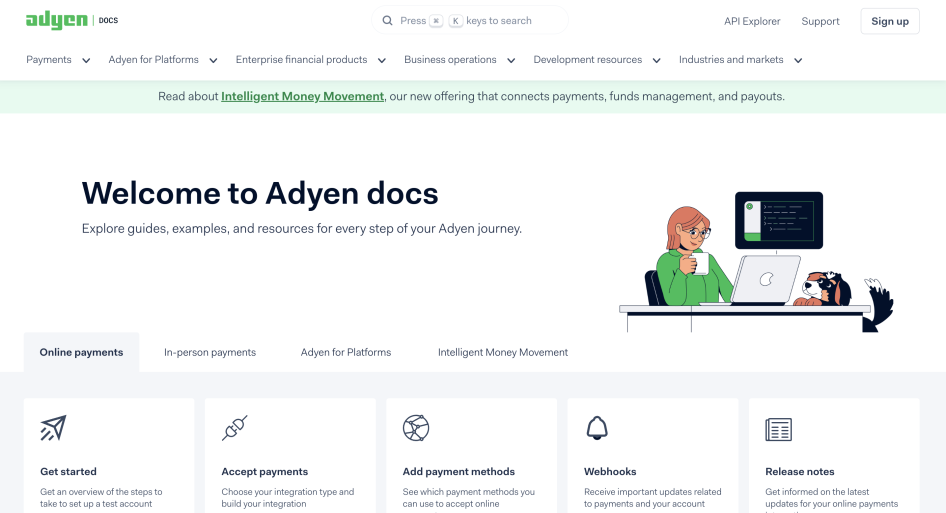
Adyen powers global commerce for enterprise platforms like Meta, Uber, and eBay. The Adyen Developer Portal is the front door to our entire financial engine. Building software that touches money is stressful, so we design our portal to give developers complete confidence whether they are integrating a web checkout, setting up physical point-of-sale card readers, or launching embedded banking services across global markets.
Instead of forcing developers to jump between disconnected microsites, we unify our entire API footprint under a consistent documentation pattern. When merchants need a specific slice of our ecosystem, our configurators and targeted subsites give them exact, parameter-matched guides without distracting clutter. We also optimize for dual audiences - both humans and AI agents, offering a dedicated Markdown repository, llms.txt indexing, and frontmatter metadata so AI assistants can retrieve clean context without hitting rate limits or broken links.
Behind the scenes, a team of 15 technical writers supports hundreds of contributing engineers using custom in-repo developer skills, and SDK-compiled code snippets. We actively analyze Unwrap customer ticket data and survey data to prioritize our work, ensuring every doc improvement directly solves real merchant friction.
NOMINATION RATIONALE
1) BEST UNIFIED OR FEDERATED ENTERPRISE DEVELOPER PORTAL
Why is this category a strong match?
Global commerce is inherently fragmented. A single merchant might facilitate online checkout in Europe, physical card readers in US stores, card issuing, platform split-payments, and dynamic regional compliance. Behind the scenes at Adyen, hundreds of engineers build across dozens of specialized product lines. If every internal team published docs independently, our portal would turn into a chaotic mess of conflicting API patterns and redundant pages.
We have 15 technical writers to prevent that friction. We build templates, single source of truth, and automated tooling so our documentation scales exponentially without requiring an exponential headcount. We serve as the strategic bridge between internal developers and the merchants building businesses on our platform.
When merchants need a specific slice of our ecosystem, we do not force them to navigate irrelevant features. We build targeted guides that expose users to exactly the piece of the Adyen platform they need without confusing them. We also build for dual audiences. We federate our complex API landscape into a clean interface for human web browsers and a structured, agent-ready environment for AI assistants.
In what ways does your portal shine in this category?
We combine merchant-focused UX tools, custom agentic workflows, and data-driven prioritization to scale our documentation alongside hundreds of engineers.
We reduce cognitive load by giving merchants control over what they see. Our Configurator enables developers to select their exact integration parameters and receive documentation matching their specific setup. When a project calls for a tailored view, we launch targeted subsites and hidden guides. These specialized entry points expose merchants to the exact piece of the ecosystem they need, cutting out distraction while keeping them anchored to our core platform standards.
Analysis of our traffic logs showed that 11.6% of our 10 million monthly requests came from AI bots, with 78% of generative AI traffic coming from user-direct assistants fetching logic while developers code. To eliminate the friction of bots crawling HTML pages, we published a dedicated Markdown repository synced directly with docs.adyen.com. We implemented the llms.txt standard, added frontmatter metadata, provided a Copy to Markdown UI feature, and aligned with Model Context Protocol (MCP) standards so AI agents get immediate context without hitting rate limits or broken links.
We build our own agentic tools to keep our writers aligned with hundreds of internal developers. We deploy automatic agentic workflows to handle release notes across Web, iOS, and Android platforms. Low-cost models monitor code repos to detect undocumented releases of Drop-in and Components, while higher-reasoning models draft style-guide-compliant release notes, bump version numbers across pages, and merge requests for writer review. Inside our primary repository, we provide developers with custom skills like edit-openapi-annotations so engineers can maintain OpenAPI annotations natively in their coding environment while CodeRabbit validates changes during pull requests.
We do not guess where our docs need work. We actively consult Unwrap data to analyze real customer support trends and friction points. Accessing this data helps us directly understand customer needs, prioritize team sprints, and focus our writing resources where they make the largest impact on merchant success.
All code snippets across our guides and API reference are automatically compiled directly from our production SDKs across .NET, Java, Python, TypeScript, Ruby, PHP, Go, and curl.
Unified Product Integration Guides
Point of Sale and Hardware Orchestration
Interactive API Reference and Explorer