Aktif Tech
NOMINEE OVERVIEW
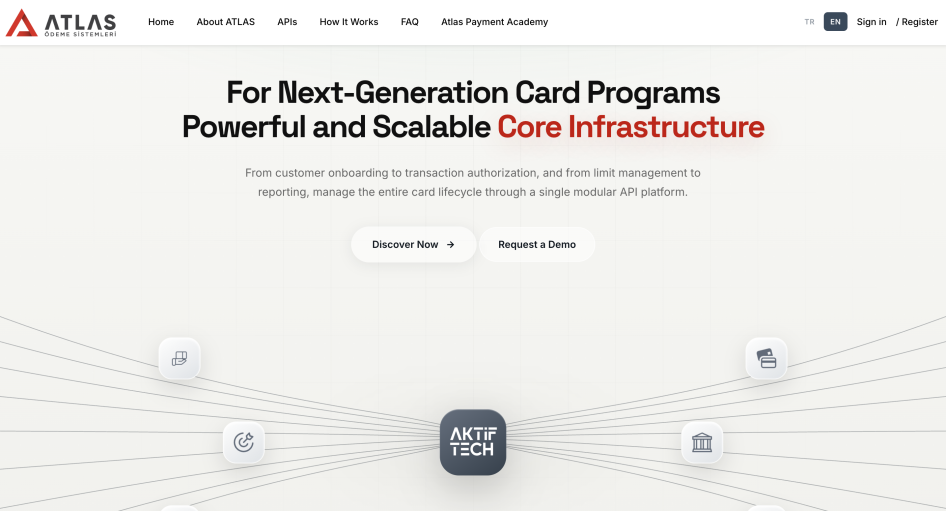
ATLAS Developer Portal transforms Aktif Tech’s extensive technology and operational expertise in card and payment systems into a developer-focused integration experience. It enables financial institutions, payment institutions, electronic money institutions, and technology teams to discover services within the ATLAS ecosystem, access technical documentation, and manage their integration processes more efficiently and rapidly.
ATLAS brings together critical components of the card payments ecosystem including issuer and acquirer processing, card management, switch & authorization, ATM management, fraud & chargeback, clearing & settlement, and digital payment capabilities within an end-to-end platform approach. Today, the ATLAS infrastructure supports more than 20 million cards, 100,000 POS terminals, and 16 financial institutions, while enabling high-volume payment operations with a processing capacity of up to 4,500 TPS and an average transaction processing time of approximately 250 ms.
ATLAS Developer Portal makes this powerful and scalable technology infrastructure accessible through a developer-friendly experience. The portal enables developers to discover relevant services, explore API details and technical requirements, and access the information they need throughout the integration process from a centralized environment.
In this way, ATLAS transforms its proven card and payment technology capabilities, already operating at scale in real-world payment environments, into a scalable digital ecosystem that developers can easily discover, evaluate, and integrate into their projects.
NOMINATION RATIONALE
1) BEST API PRODUCT MICROPORTAL INSIDE A DEVELOPER PORTAL
Why is this category a strong match?
ATLAS Developer Portal is a strong fit for this category because it transforms a comprehensive card and payment technology platform, operating at significant scale in real-world environments, into focused, understandable, and product-oriented experiences for developers.
Card payment systems consist of numerous interconnected components with distinct technical and operational requirements, including card lifecycle management, authorization, transaction management, merchant and terminal operations, ATM management, fraud prevention, chargeback, and clearing & settlement. Making the extensive capabilities of ATLAS which currently serves more than 20 million cards, 100,000 POS terminals, and 16 financial institutions easy for developers to understand and navigate is a fundamental principle behind the portal experience.
Rather than presenting this complex structure simply as an extensive collection of technical documentation or a list of APIs, ATLAS Developer Portal organizes relevant services into meaningful product-oriented experiences based on specific business needs and capabilities. Each product area enables developers to focus on the relevant solution according to its purpose, capabilities, technical scope, and integration requirements.
This approach allows developers to focus on the products and services relevant to their specific integration scenarios without getting lost within the broader technological scope of ATLAS. They can understand the capabilities of the relevant product area and access the technical information they need within the same product journey.
ATLAS therefore combines the scale of a comprehensive, high-volume payment technology platform with the focused developer experience of product microportals. It enables each product area to communicate its own business value and technical scope while maintaining a consistent overall user experience and technology approach across ATLAS.
In what ways does your portal shine in this category?
One of the key strengths of ATLAS Developer Portal in this category is its ability to transform the inherently complex technical architecture of card and payment systems into clear, focused product experiences that guide developers from business need to integration.
The different capabilities within ATLAS are not entirely independent services. From creating and managing a card product to authorizing transactions, from transactions performed through POS terminals or ATMs to clearing and settlement, and from fraud controls to chargeback processes, multiple components operate as interconnected parts of the same payment ecosystem. The portal preserves this holistic relationship while enabling developers to focus specifically on the product areas and services relevant to their needs.
Through its product-oriented structure, users can understand the purpose and functionality of a service, explore its technical details, and access the information required for integration within a centralized experience. Developers are therefore provided with more than an endpoint or technical reference: they can also understand the role of an API within the broader payment flow, the need it addresses, and the context in which it can be used.
This approach reduces cognitive load in an environment such as payment systems, where technical and operational dependencies are particularly complex. It makes relevant services easier to discover and enables developers to begin integration with a clearer understanding of the overall context. At the same time, presenting different ATLAS products through a consistent design and navigation approach helps maintain a coherent developer experience when moving between product areas.
Making a high-volume payment infrastructure capable of processing up to 4,500 TPS with an average transaction processing time of approximately 250 ms accessible through the developer portal also demonstrates that the portal experience is backed by proven, scalable technology operating in real-world payment environments.
2) BEST UNIFIED OR FEDERATED ENTERPRISE DEVELOPER PORTAL
Why is this category a strong match?
ATLAS Developer Portal is a strong match for this category because it brings together the various capabilities of a comprehensive card and payment technology platform at a single access point for developers.
ATLAS covers interconnected areas such as card management, transaction authorization, POS and ATM management, fraud and chargeback processes, clearing, and settlement. Each of these areas has distinct technical information and integration requirements. The portal enables developers to discover the services they need within this broad structure, review the relevant documentation, and understand the role of those services in payment processes.
In this way, ATLAS’s different products and services become a consistent experience that developers can evaluate within a shared structure, rather than a fragmented collection of technical resources.
In what ways does your portal shine in this category?
ATLAS Developer Portal stands out by allowing developers to discover, understand, and try out a payment service in the same environment. Users can explore card payment services, access API documentation, try services in a test environment, and view request–response flows.
The portal’s product- and service-oriented structure makes it easier for developers with different needs to find relevant content. For example, a team working on card management and a team dealing with POS transactions or authorization processes can assess the technical information relevant to their respective integration scenarios through the same portal. This structure also makes the relationships between services visible, helping developers understand the role of each capability in the broader payment flow.
This developer experience is built on a platform that supports high-volume operations. Today, ATLAS serves more than 20 million cards, 100,000 POS terminals, and 16 financial institutions, with a processing capacity of up to 4,500 transactions per second. The portal makes the services of this large-scale platform accessible and available for developers to examine.
3) BEST REIMAGINED ONBOARDING EXPERIENCE IN A DEVELOPER PORTAL
Why is this category a strong match?
ATLAS Portal is a strong match for the “Best Reimagined Onboarding Experience” category because it transforms a traditionally complex, fragmented and highly manual integration journey into a structured, transparent and developer-focused experience.
Integrating with a card and payment processing platform involves far more than gaining access to an API. Developers must understand domain-specific processes, obtain and manage credentials securely, test integrations in a controlled environment, coordinate certification activities and monitor their progress towards readiness. Before ATLAS Portal, much of this journey relied on email-based coordination, documentation distributed across different channels, lengthy credential procedures and repeated interaction with technical support teams.
ATLAS Portal brings these previously disconnected steps into a single digital environment. Developers can access centralised API documentation and practical examples, manage API credentials, test APIs interactively, work within role-based access controls and track the progress of their onboarding journey.
This is not simply a visual redesign of an existing portal. It is a reimagining of how financial institutions and their technical teams begin working with a mission-critical card and payment platform. By making requirements, tools and next steps visible from the outset, ATLAS Portal reduces uncertainty, accelerates access to the sandbox environment and decreases dependency on repeated support interactions.
The result is an onboarding experience that combines developer usability with the security, governance and operational discipline required in the payments industry.
In what ways does your portal shine in this category?
ATLAS Portal shines by turning onboarding from a support-led sequence of disconnected tasks into a guided and observable integration journey.
Its key strength is the way it brings together the capabilities developers need at the beginning of an integration. Centralised API documentation and examples help teams understand not only how an endpoint works, but also how it fits into the wider card and payment processing context. Interactive API testing enables developers to explore and validate services directly, shortening the distance between reading the documentation and beginning implementation.
Credential management is incorporated into the same experience, reducing the delays and uncertainty associated with manual credential exchanges. Role-based access supports secure collaboration by ensuring that users can access the functions and information relevant to their responsibilities. Progress and status tracking provide visibility into completed activities, outstanding requirements and the next steps in the onboarding process.
This visibility is especially valuable in payment technology, where onboarding may involve several technical and operational stakeholders as well as testing and certification requirements. Instead of relying on long email threads or repeated status requests, teams can follow a more consistent and transparent path.
The portal’s strongest qualities are:
- A unified source for API documentation and implementation examples
- Interactive testing that helps developers move into hands-on exploration faster
- Secure and structured API credential management
- Role-based access designed for multi-stakeholder integration teams
- Progress visibility throughout onboarding and testing
- Faster access to the sandbox environment
- Reduced reliance on recurring technical support
Together, these capabilities make onboarding more understandable for developers, more manageable for integration teams and more scalable for ATLAS.