Gracenote, a Nielsen company
NOMINEE OVERVIEW
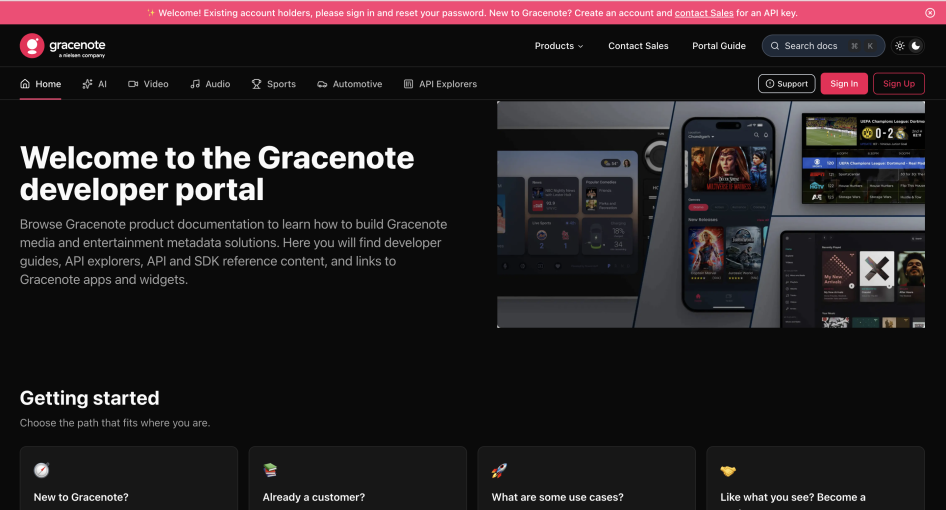
Welcome to the Gracenote developer portal.
Browse Gracenote product documentation to learn how to build Gracenote media and entertainment metadata solutions. Here you will find developer guides, API explorers, API and SDK reference content, and links to Gracenote apps and widgets.
NOMINATION RATIONALE
1) BEST REIMAGINED ONBOARDING EXPERIENCE IN A DEVELOPER PORTAL
Why is this category a strong match?
The portal reimagines onboarding around one idea: documentation should help developers reach a first successful call fast, not just describe what the API does. Three conventions we challenged:
- "Docs and answers live in different places." The Doc Chat opens from any page with the current product and topic already in context. A developer reads a topic, asks a question, gets a doc-grounded answer with links back to the source page, and keeps moving. The read/ask loop replaces the "read, get stuck, leave to search elsewhere" pattern.
- "Onboarding is for humans reading pages." For MCP server products, developers can download the full documentation as markdown or PDF and feed it to their AI coding assistant. The AI gets the same data-model context a human gets from the
portal. AI clients are onboarded alongside human developers. - "You must log in before you can evaluate the API." Documentation and interactive explorers are public. The security boundary is the API key, not the documentation. A prospective customer can read, explore, and ask the Doc Chat freely before any
commercial commitment.
In what ways does your portal shine in this category?
The before state: A developer integrating a Gracenote product had to identify the right documentation system (Mashery, Stoplight, or S3-hosted Flare depending on the product vertical), contact separate teams for API keys, and reconcile data definitions from
disconnected sources, with no self-service path for questions.
The after state: The landing page routes developers by intent before they pick a product. Three entry points:
- "Getting started" has six entry-point cards: "New to Gracenote?" (links to About), "What are some use cases?" (scrolls to use-case cards), "What are the APIs?" (scrolls to live examples), "Become a customer" (routes to Sales), "Already a customer?" (links to product verticals), and Doc Chat as a first-class card: Because it is so useful, the chatbot is presented as a starting point, not a secondary feature.
- "What do you want to build?" maps eight use cases to products. This shortens the path to the documentation for developers who know what they want to build but are not sure which API or products to use.
- "Explore Gracenote APIs" shows live request/response examples with language switching and a "Try in Explorer" link before any sign-up, so developers see a real call pattern immediately.
- When logged into the portal, developers can find the Doc Chat button on every page, pre-loaded with the current product and topic. A developer who gets stuck mid-read asks the assistant in context, gets a grounded answer, and clicks the source link back to the right page. No leaving the docs to search elsewhere.
Additional onboarding capabilities:
- AI-first access: Model Context Protocol (MCP) server products offer downloadable markdown and PDF documentation for use in AI coding assistants; select AI agents can access the portal directly
- Controlled vocabulary search: Algolia-powered product-scoped search with a synonym map resolves product-name variants and terminology differences so developers find the right content regardless of how they phrase a query
- Access controls: proprietary documentation is protected through gated API keys and scraper controls, while evaluation documentation stays publicly accessible
2) BEST DEVELOPER PORTAL FOR API DATA PRODUCTS
Why is this category a strong match?
As a B2B metadata provider powering global streaming, sports, and automotive platforms, Gracenote's developer portal helps technical users understand complex data products through:
- Interactive API explorers and live "Try It" calls
- Data dictionaries and controlled vocabularies
- Downloadable schemas and implementation guides
- A Doc Chat assistant grounded in authoritative documentation
For AI-native Model Context Protocol (MCP) server products, downloadable markdown and PDF documentation let developers supply complete data-model context directly to AI coding assistants. Two documentation engineers built the platform in one year, covering 19 data products across five verticals, previously fragmented across Mashery, Stoplight, and an S3-hosted Flare site.
In what ways does your portal shine in this category?
The portal brings together 19 data products through multiple discovery paths: use-case mapping, vertical landing pages, product-scoped search, and a context-aware Doc Chat assistant. Rich data assets (data dictionaries, controlled vocabularies, and implementation guides) sit alongside API references, giving developers the data-model context they need to integrate successfully.
Operationally, the portal is built for accuracy and reliability:
- API keys aligned to contract-specific entitlements are provisioned through an in-house admin dashboard
- Lifecycle changes and release updates are published simultaneously to portal docs, the Doc Chat knowledge base, and downloadable files via automated CI/CD, with CRM customer notifications coordinating alongside
- Doc Chat accuracy is validated continuously through an automated quality pipeline running 503 test queries across 4 dimensions of anti-hallucination testing:
- Factual grounding (4.6/5, equivalent to 0.92 on the standard 0–1 RAGAS scale): Answers stay within documented sources; the system says so when documentation is insufficient, rather than generating plausible-but-incorrect responses. This score deliberately exceeds the overall 4.4/5 quality score: accuracy over completeness.
- Jailbreak resistance (3/3 blocked): Three categories of adversarial prompts were tested: persona-override attacks, system prompt extraction, and credential/PII requests. All were correctly refused.
- Credential and security refusals: Requests for API keys, admin passwords, customer lists, and internal contacts were all correctly refused without per-query coaching.
- Anti-sycophancy: False premises are pushed back on rather than agreed with.
Of the 8% of queries that scored below the quality bar, 90% were off-topic or adversarial questions the chatbot correctly refused. Only 4 of 503 queries (0.8%) identified genuine documentation gaps, which the doc team is working to fix.
3) BEST UNIFIED OR FEDERATED ENTERPRISE DEVELOPER PORTAL
Why is this category a strong match?
Gracenote's API portfolio spans five business verticals (video, sports, audio, automotive, and AI), covering 19 products across two API gateways, REST and MCP server interfaces, and both JSON and XML data formats. Before the portal, documentation for these products was split across three separate systems: the Mashery portal (Sports and Video), Stoplight (Audio and Automotive), and an S3-hosted Flare site, each with its own API explorer and no shared navigation or authentication.
The developer portal unifies all of this into a single branded experience with consistent navigation, unified authentication, product-scoped search, and a "My API Keys" page that puts provisioned keys in front of developers exactly where they need them.
In what ways does your portal shine in this category?
The portal consolidates 19 products into one experience while accommodating backend differences in data format, API gateway, and authentication. Key differentiators:
- Unified navigation and domain model: the landing page surfaces the portfolio two ways: category cards organized by vertical ("Learn About Gracenote Products") link to each vertical's index, and a "What do you want to build?" section maps eight use cases
directly to products. Users get both a domain-model path and a task-based path into the same 19-product catalog from a single starting point.
- Algolia-powered search: product-scoped search built on Algolia, replacing an earlier home-grown implementation, delivers fast and relevant results across all 19 products with full search analytics
- Embedded Doc Chat: answers questions grounded in authoritative documentation across all product verticals, keeping developers in one place and provides links back to the documentation source on the developer portal.
- In-house admin dashboard: used by Customer Care to provision API keys for all 19 products from a single interface, replacing a fragmented multi-vendor workflow; authenticated users can view and copy their provisioned keys via "My API Keys"
directly in the portal
- CI/CD pipeline with strict quality gates: documentation changes publish simultaneously to portal pages, the Doc Chat knowledge base, and downloadable files
- CRM-integrated analytics: usage data and support routing feed continuous operational feedback